Geography
Ibiza – A Little Bit of Geography

Geographic Location
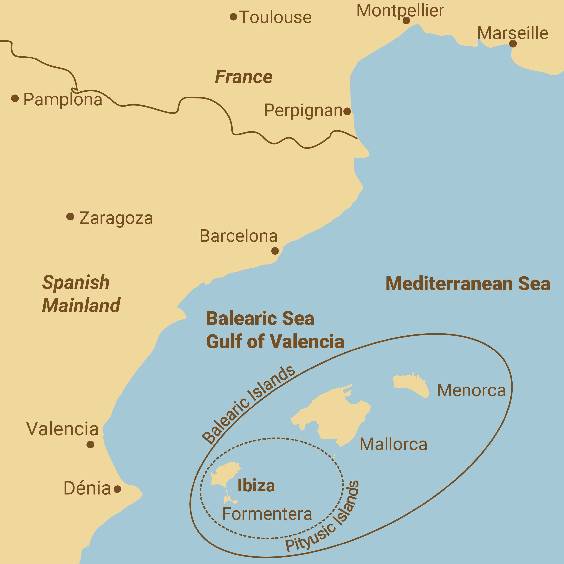
Ibiza is an island in the western Mediterranean Sea. This part of the Mediterranean Sea is also called the Balearic Sea or the Gulf of Valencia. It is part of the Balearic Islands; the other inhabited Balearic Islands are Mallorca, Menorca, and Formentera. Formentera is directly adjacent to Ibiza. Ibiza and Formentera together are also called the Pityusic Islands.
The nearest point on the mainland is near Dénia, approximately 55 miles (88 kilometers) west. The city of Barcelona is 155 miles (250 kilometers) away, and the African mainland is approximately the same distance to the south.
Ibiza Town is at 38° 55′ N, 1° 26′ E. It is at approximately the same latitude as Athens, Greece; Washington, DC; Sacramento, CA; or Cangzhou, China. It is slightly east of cities like London, UK, or Paris, France. Yet it is in the Central European Time zone, like Paris but unlike London. Hence, solar noon is later than one would expect, especially during daylight saving time.
Ibiza is the internationally common name of the island; however, its official name is Eivissa.
Administration
Ibiza is part of Spain and therefore belongs to the European Union. Within Spain, the region is called the Balearic Islands Autonomous Community, which geographically corresponds to the archipelago. Unlike the Canary Islands, the Balearic Islands are fully part of the European Union, including for tax purposes. That means there is no duty-free shopping on flights between airports within the European Union.
The capital of Spain is Madrid; the region's capital is Palma de Mallorca. Due to geographic and cultural ties, there are traditionally strong links with Barcelona, Spain's second-largest city and the capital of the Catalonia region.
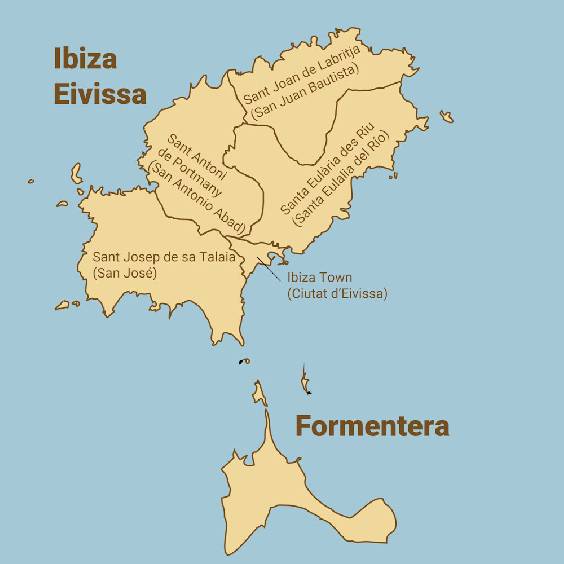
Ibiza itself is divided into 5 municipalities. One is referred to as Ibiza Town (or also Eivissa Town, or just "Vila"). The other municipalities cover more or less a quarter of the island each. These are rather administrative units comprising several towns, villages, and resort towns.
The Island
The island has a surface of 221 square miles (572 square kilometers). That's only one-seventh the size of the neighboring island of Mallorca or of Long Island in the northeastern United States (1,400 square miles, 3,600 square kilometers). However, it's about three times the size of Aruba in the Caribbean (69 square miles, 180 square kilometers).
From the southwestern end of Ibiza to the northeastern end, it's less than 25 miles (40 kilometers). From southeast to northeast, it's less than 15 miles.
Around Ibiza, there are several smaller islands and rocks. The larger among these small ones are Es Vedrà, Espalmador, and Tagomago (approx. 100 acres or 40 hectares).
The highest elevation on Ibiza is Mount Sa Talaia, at 1,558 feet (475 meters). The island includes both flat areas and mountainous areas. In some places, such as Cap Llentrisca, cliffs rise very steeply, more than 1,350 feet (412 meters) above sea level, which is really impressive.
There are no year-round rivers or creeks on Ibiza. It is said that the Riu de Santa Eulària used to have water even in summer in earlier times, but due to increasing water demand, this is no longer the case.
Population
Ibiza had a population of approx. 164,000 in 2025. The island is developing rapidly; 20 years earlier, only around 111,000 people were living on the island. Thus, the island is densely populated, with 731 people per square mile (282 people per square kilometer).
Traditionally, the only city on the island is Ibiza Town. People used to live spread out across the land on their farms ("fincas"). In recent decades, Santa Eulària and Sant Antoni have become notable towns. Furthermore, several resort towns have been developed.
Transportation
There is one airport with one runway on the island. It serves both commercial flights and general aviation. There is also one major port for ferries, cruise ships, and freight. Ibiza's road system is well developed. There are highways connecting the major locations on the island. One hour is enough to travel from one end of the island to the other. There is no railway system on the island; public transportation relies on buses and ferries.
Climate
Ibiza has a typical Mediterranean climate. The summers are mostly dry and rather hot. Due to the sea, summers usually don't get too hot. At least there is some cooling from the wind. Winters are mild but rather humid. Powerful and sometimes dangerous are the "DANA" rainfalls, which sometimes occur in autumn. In a short time, massive rainfall can occur and cause flooding. Ibiza is in a semi-arid climate zone, meaning that for most of the year, less precipitation falls than water evaporates.
Vegetation Cypress trees, especially savins, and pine trees are typical of Ibiza. In rural areas, the air is filled with a scent of herbs like rosemary or thyme. Despite the scent, some of them are poisonous. A significant area is covered more by bushes than by trees. At the seaside, trees have often grown in unusual shapes due to wind and other influences from the sea. In gardens and urban parks, palm trees are also quite common.